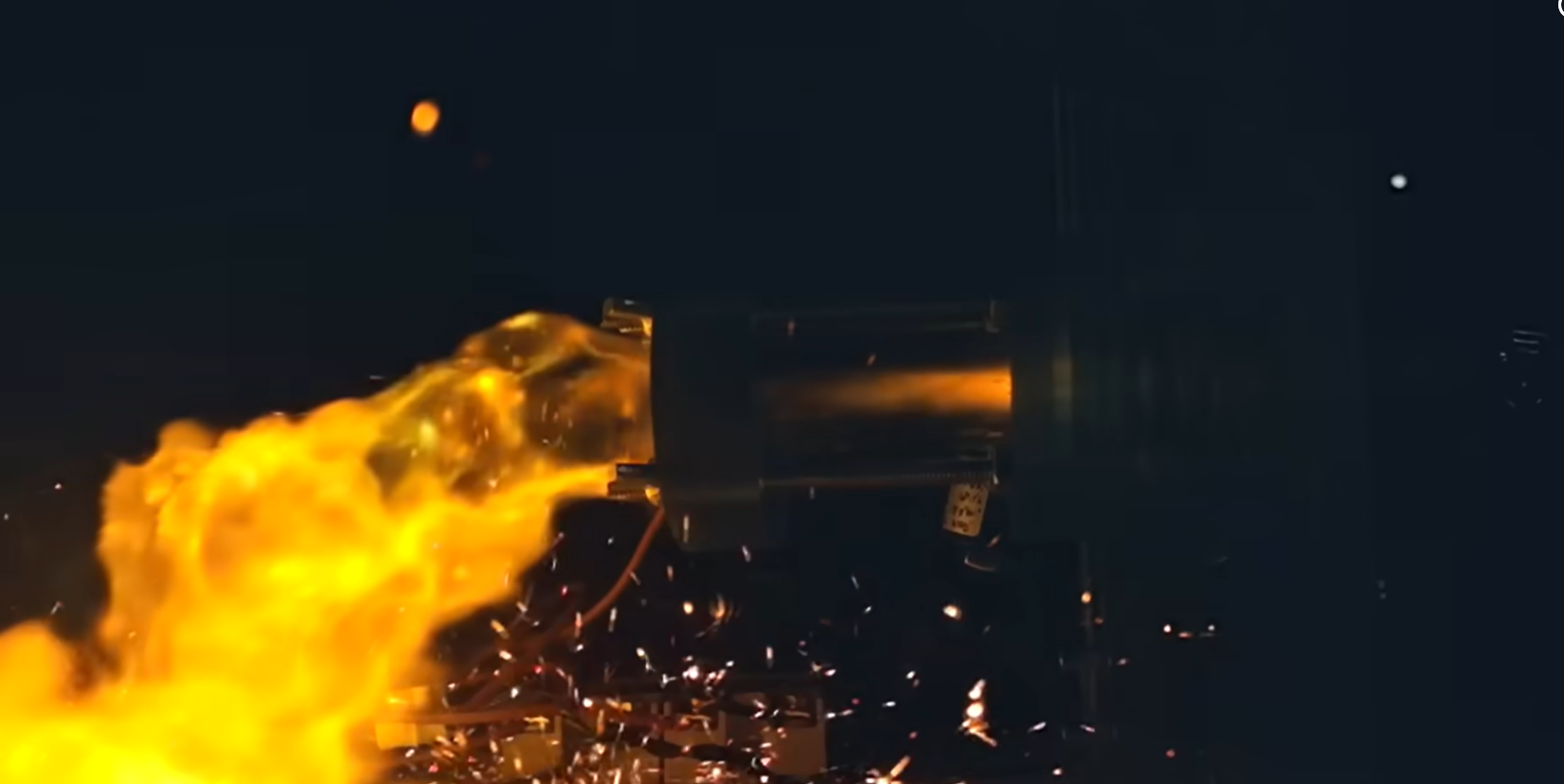
Video of fire: https://drive.google.com/file/d/1TIkgghlDtHngZemIkRoBfozpgZ5ZmmUi/view?usp=sharing

Enriching the oxidizer pushed performance substantially: thrust topped out around 50 pounds on plain atmospheric air at 40 lb/min of airflow, but climbed past 200 pounds at air flows above 130 lb/min once the oxidizer was enriched to nearly 25 percent oxygen, with no upper flow limit found in testing. The more interesting result was what happened as air mass flow climbed toward that upper range: the single detonation wave didn't fail cleanly, it grew progressively less steady, with the standard deviation of its lap time rising linearly with airflow, before the engine snapped into a second, co-rotating detonation wave. Once two waves were established above roughly 115 lb/min, wave steadiness dropped back down to match the best single-wave runs, and specific thrust, which had stalled during the unstable transition, resumed its earlier linear climb. The transition itself was sharp rather than gradual, the shift from exclusively one wave to predominantly one wave occurred over less than a half percent change in air mass flow, and no run was ever caught sitting stably at a roughly even split between one-wave and two-wave operation. Together, these results make the case that letting an RDE self-organize into multiple co-rotating detonation waves is a viable way to reach higher thrust without sacrificing the steady, low-pressure-fluctuation operation that makes RDEs attractive over pulsed detonation engines in the first place.