
Digital Twin of a Cantilever Beam
A cantilever beam digital twin that pairs a low-cost IMU with Euler-Bernoulli beam theory and a Nodal Discontinuous Galerkin FEA solver to compute live stress, strain, and deflection, then renders the result as a deforming 3D beam on a browser dashboard. Built to prove that physics-informed digital twins can deliver trustworthy, real-time structural diagnostics, a capability aimed at eventually letting engineers monitor and diagnose failing satellite components remotely, without a human in the loop.
Year
2026
Month
April
This project set out to test whether digital twin technology, a live, sensor-driven virtual replica of a physical structure, can accurately capture the real-world structural behavior of a loaded beam in real time. The underlying question was whether inexpensive, commercially available sensing, paired with classical beam theory and a modern PDE solver, could produce structural readings fast and accurate enough to be trustworthy for engineering decisions. The long-term motivation is aerospace: no engineer can walk out and inspect a bent solar panel truss or a fatigued antenna boom on an orbiting satellite. If a digital twin can be proven accurate on a benchtop cantilever beam, that same architecture, sensor plus physics-based backend plus live dashboard, becomes a template for remotely monitoring and diagnosing failing structural components on spacecraft without requiring a human anywhere near the hardware.
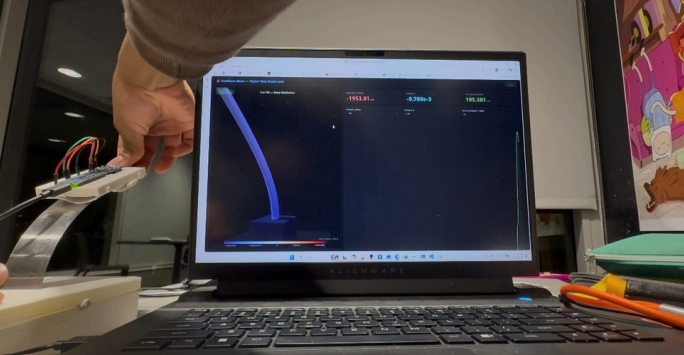
To build it, I mounted an Adafruit BNO055 nine-axis IMU near the free end of a cantilevered ASTM A1008 steel beam, fixed at the base to keep a clean, well-characterized boundary condition. As the beam deflects under load, the IMU's onboard sensor fusion outputs orientation and rotational rate data, streamed over an Arduino Nano 33 IoT to a Python backend. Rather than treating that reading as the final answer, the backend runs it through two layers of physics: Euler-Bernoulli beam theory to relate the measured tip rotation to bending moment and curvature along the beam's length, and a Nodal Discontinuous Galerkin finite element solver to numerically resolve the beam's stress, strain, and deflection field from that boundary information. That combination is what makes it a digital twin rather than just a sensor readout. The physical sensor anchors the virtual model to ground truth in real time, while the FEA layer reconstructs the full structural state the sensor alone can't see.
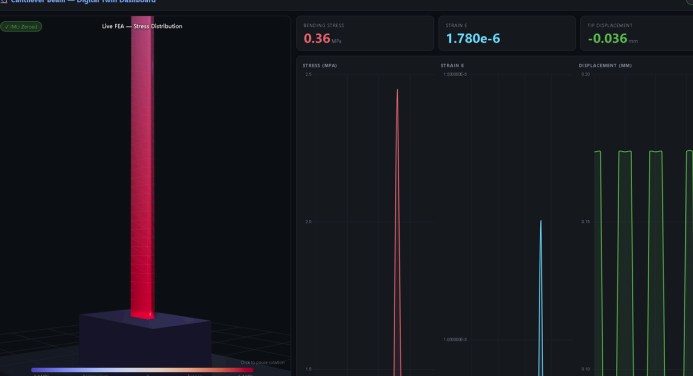
The result is a live browser dashboard that updates continuously as the beam moves: numerical stress, strain, and deflection values, time-series charts tracking how those metrics evolve, and a 3D, color-mapped beam rendered in Three.js that deforms and recolors in sync with the physical beam sitting beside it. Watching the virtual beam bend the instant the real one does is the clearest proof that the pipeline works end to end, from IMU to Arduino to Euler-Bernoulli mechanics to Discontinuous Galerkin solver to WebGL rendering, with no meaningful lag. That real-time fidelity is the whole point: it demonstrates that a lightweight, commercially available sensor stack paired with the right physics-based backend can deliver trustworthy structural diagnostics without a human standing next to the hardware, exactly the capability a remote satellite health-monitoring system would need.